
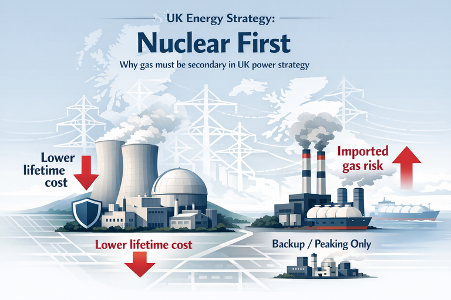
Why gas must be secondary in UK power strategy
Nuclear First
This policy brief argues that a nuclear-first strategy offers the UK a stronger long-term energy model than a gas-first approach on financial and strategic grounds alone. Over an 80-year horizon, the paper estimates that gas-based expansion would cost roughly £830bn–£1,200bn, compared with about £430bn–£580bn for nuclear, with much of the gas expenditure flowing abroad through imported fuel. The brief contends that nuclear therefore provides lower lifetime costs, greater domestic economic retention, and a more secure platform for long-term industrial growth.
The document also argues that a large-scale gas strategy would quickly exhaust domestic reserves and lock the UK into long periods of import dependence, while nuclear benefits from a more diversified fuel supply chain and longer operating lives. It recommends designating nuclear as the country’s primary baseload power source, limiting gas to balancing and strategic industrial uses, accelerating Rolls-Royce SMR deployment, pursuing multi-unit conventional nuclear sites, simplifying regulation, and using long-term nuclear power agreements to attract major industrial and data-centre investment.
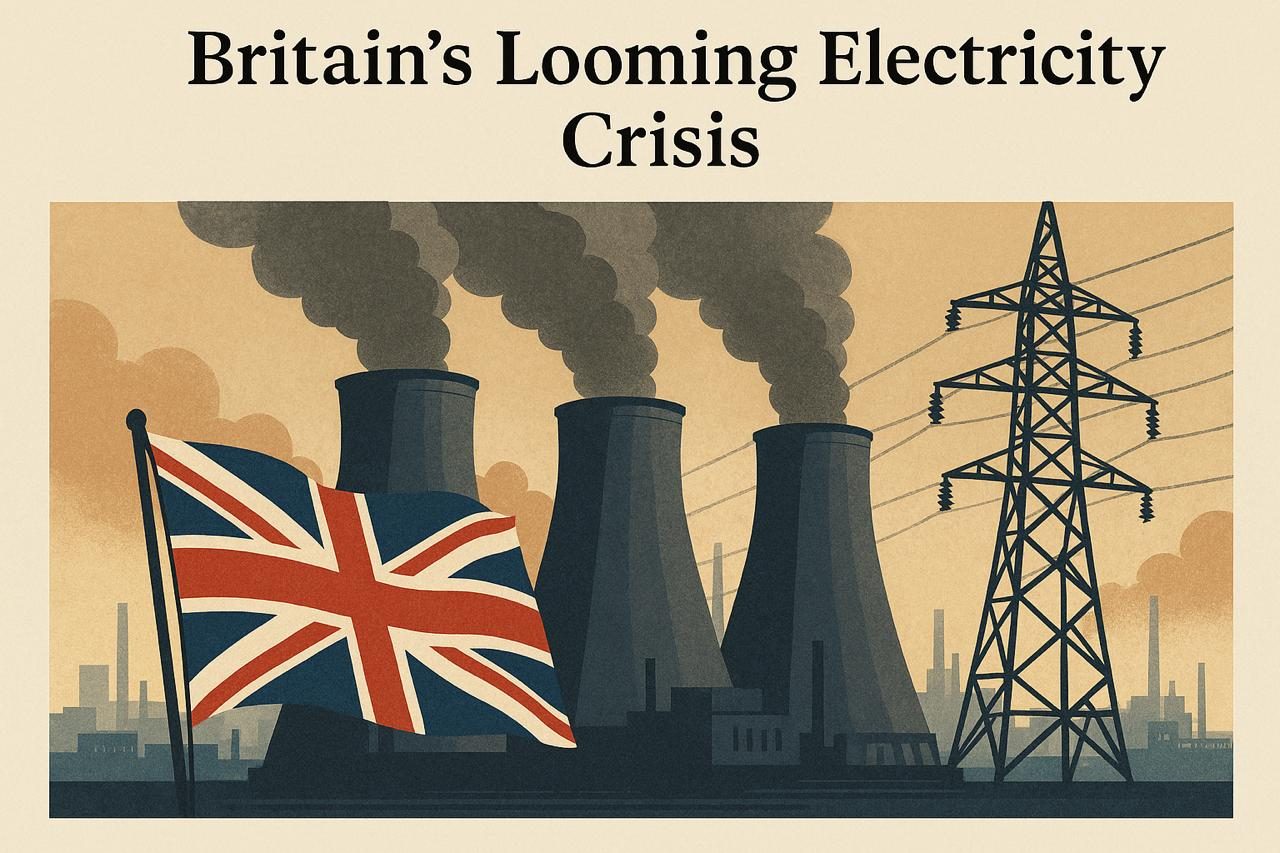
From Powerhouse to Power Shortage
Britain’s industrial electricity prices are among the highest in the developed world because successive governments dismantled the country’s supply of firm, dependable power. Coal was eliminated, nuclear was delayed, and gas was constrained without credible replacement, leaving the system short of electricity that can run day and night. The result is tighter supply, higher wholesale prices, lost manufacturing capacity and a growing dependence on imports.
Recovery depends on restoring “core electrons”: electricity that can be produced on demand. This requires maximising North Sea oil and gas, accelerating nuclear—especially small modular reactors—and rapidly repurposing former coal power station sites for modern, high‑efficiency generation with carbon capture. These brownfield sites already have grid connections, infrastructure and skilled workforces, making them the fastest route back to reliable capacity.
Cheap, abundant electricity the foundation of national renewal. Restoring firm power would make steel, aluminium, critical minerals processing and large‑scale recycling competitive again, while enabling energy‑intensive food production to improve self‑sufficiency. The conclusion is blunt: without rebuilding a backbone of reliable power, Britain will remain trapped with high costs and industrial decline; with it, prices fall, factories return and long‑term economic resilience is restored.
How a 60-Year Climate Doomsday Narrative Is Driving Britain’s Economic Suicide
Rethinking Net Zero:
The United Kingdom’s commitment to achieving net-zero carbon emissions by 2050 is based on two flawed assumptions: that catastrophic, human-driven global warming is inevitable, and that the UK can meaningfully influence the global climate through its actions. These assumptions are not supported by long-term scientific evidence and the Net Zero agenda is more a product of a persistent doomsday narrative than a rational response to climate realities.
Key Arguments
- Historical Context & Climate Science:
The document traces the evolution of climate narratives over the past sixty years, highlighting how media and political messaging have shifted from fears of a new ice age in the 1970s to global warming in the 1980s and beyond. It emphasises that Earth’s climate has always changed due to natural cycles, particularly orbital mechanics (Milankovitch cycles), and that current warming trends fit within these long-term patterns. The paper argues that the scientific consensus has often been misrepresented in public discourse, with fear and urgency used to justify sweeping policy changes. - Critique of Net Zero Policy:
The author asserts that Net Zero has led to the decline of key UK industries, including automotive manufacturing and oil refining, and has undermined energy and food security. The transition to electric vehicles and renewable energy is described as being driven by mandates rather than market demand, resulting in job losses, higher costs, and increased dependence on imports. The paper claims that these sacrifices cannot meaningfully alter global climate patterns, given the UK’s small share of global emissions. - Economic and Strategic Risks:
The document details how climate policies have increased energy prices, reduced domestic production, and made the UK more vulnerable to external shocks. It argues that offshoring emissions and industries has paradoxically increased global emissions while weakening Britain’s economy. - Policy Recommendations:
the author recommends leaving all international climate agreements including UNFCCC, Paris agreement, Kyoto protocol and climate change act
Conclusion
The central claim is that climate change is a natural, ongoing process, and that current UK policy is sacrificing economic resilience and sovereignty for symbolic emissions targets. The author advocates for a shift towards evidence-led, resilience-focused climate policy that prioritises national strength and adaptability over adherence to international agreements and ideological targets.

Digital Identity in the UK:
The UK government is reconsidering digital identity systems, which promise efficiency and fraud reduction but also pose significant risks based on past experiences and international examples. The debate involves balancing convenience, privacy, security, and inclusion.
- Benefits of digital ID: Digital identity could streamline access to services, reduce fraud, and foster economic innovation, aligning with the growing trend of online transactions.
- UK historical challenges: Previous UK initiatives like the Identity Cards Act, NHS IT program, and COVID-19 vaccine passports faced public mistrust, high costs, and technical difficulties, highlighting risks in large-scale identity projects.
- International lessons: Denmark’s NemID shows success with strong safeguards and integration, while India’s Aadhaar and China’s social credit system reveal dangers of exclusion and authoritarian misuse.
- Key risks and policy needs: Privacy concerns, cybersecurity vulnerabilities, cost, and digital exclusion must be addressed through voluntary participation, decentralized design, legal protections, inclusive access, and transparent evaluation.